It's going to be hard to write this year without using culturally racy words... and I say culturally, because in the didactic portion of nurse-midwifery school (and the clinical) they are our every day language. We put the Vagina monologues to shame on the regular.
So, with that preface, I will recount a touching and and amusing story that happened on Thursday at my clinical site (a public Gyn clinic in a hard-knock city in Connecticut where the average age of first pregnancy can't be much over 17....)
A twenty year old hispanic girl came in to get an IUD placed. She brought her adorable 6 week old baby girl clad in pink and swimming in the biggest ensemble of carriage, blankets, stuffed animals, diaper bags that I had seen that day. She also brought her partner, who sheepishly wiped the long dark hair out of his eyes as we asked him to take a seat next to the exam table where his nervous girlfriend lay. He spoke very little English, and his girlfriend, by now wearing a hospital gown and draped in a sheet, translated each word we said.
As my preceptor gave the instructions, they both nodded in agreement "Take 2 ibuprophen when you get home, feel the strings to see if they have moved, you may have some cramping and spotting for a month... and nothing in the vagina for 2 weeks." The long haired partner sat up a little straighter - obviously understanding.
"And that includes penis." The midwife mater-of-factly said.
Her partner smiled an embarrassed smile, laughed, and looked between us and his girlfriend - his eyes saying "Are you suggesting we have sex? How could you think such a thing?" She giggled, he giggled, and the procedure began.
While grimacing during the IUD placement, her partner started laughing again. "No penis!" He blurted out. She couldn't help herself in her nerves and pain and laughed too.
As I drove away from the clinic at the end of the day, I saw the two of them walking, pushing their baby entourage, and holding hands.
It is nice to feel good about the dynamic of the young couples once in a while. And I was sure they would follow the instructions and advice they had gotten that day.
Sunday, November 18, 2007
Thursday, November 15, 2007
Was there life before pap-smears?
Ok, ok. A blog is no good if you don't write on it.... no one will read it, check it, and friends will give up on you and your determination to share the joys and pains of life on a regular basis.
I appologize, life moved out from under me and updating this blog fell through the missing spaces of free time.
I am back in school - studying to be a nurse-midwife - and it is, cliched as it may be - all that I dreamed it would be. And this dream has certainly been a long time coming... I have been talking about this since 2003 - so with two years of pre-reqs, a year of nursing school, a year of nursing, and more debt than I care to admit, I am here.
In the past 3 months I have become adept at pap-smears, staring at body fluids under the microscope, talking to young girls about the evils of douching and the joys of birth control, and more than anything, sitting at my desk reading, reading, memorizing... It is certainly not everyone's cup of tea. But it is mine - and with a little sleep under my belt and a newly vacuumed floor - I feel positive about the direction this is heading.
In the mean time, here are some pictures of Caleb and my vacation to Italy and Croatia this summer - which seems like longer ago than 4 months. Was there life before pap-smears?
Yes....


I appologize, life moved out from under me and updating this blog fell through the missing spaces of free time.
I am back in school - studying to be a nurse-midwife - and it is, cliched as it may be - all that I dreamed it would be. And this dream has certainly been a long time coming... I have been talking about this since 2003 - so with two years of pre-reqs, a year of nursing school, a year of nursing, and more debt than I care to admit, I am here.
In the past 3 months I have become adept at pap-smears, staring at body fluids under the microscope, talking to young girls about the evils of douching and the joys of birth control, and more than anything, sitting at my desk reading, reading, memorizing... It is certainly not everyone's cup of tea. But it is mine - and with a little sleep under my belt and a newly vacuumed floor - I feel positive about the direction this is heading.
In the mean time, here are some pictures of Caleb and my vacation to Italy and Croatia this summer - which seems like longer ago than 4 months. Was there life before pap-smears?
Yes....


Tuesday, April 24, 2007
Montreal
Caleb and I had a fantastic road-tripping vacation this past week from New Haven, to Burlington, and onto Montreal. It was so easy to leave the working world behind and join the land of the living and relaxing and not going to work all the time. Here are some pictures.

Emeleia - Zoe's baby. Loving her spoon while the rest of us enjoy Pepe's Pizza and some beers.

Helen and Nick. Two great New Havenites.

Sahir and Justin - narcissistic and wonderful as ever.

Caleb - yes, the sad truth of road trips. But look how beautifully blue the sky became.

Grafitti. Montreal integrates it so well into the urban landscape. It was everywhere. We decided to celebrate....
 And kiss.....

And eat....

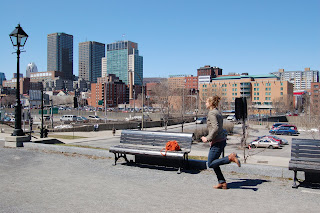

And frolic...
How fun.

Emeleia - Zoe's baby. Loving her spoon while the rest of us enjoy Pepe's Pizza and some beers.

Helen and Nick. Two great New Havenites.

Sahir and Justin - narcissistic and wonderful as ever.

Caleb - yes, the sad truth of road trips. But look how beautifully blue the sky became.

Grafitti. Montreal integrates it so well into the urban landscape. It was everywhere. We decided to celebrate....
 And kiss.....
And eat....


How fun.
Sunday, March 25, 2007
And the winner is... (better late than never)
CCSC. They won the whole darn thing. Here are some pics. Check out CCSC Hoops for more.
http://www.ccschoops.blogspot.com/
http://www.ccschoops.blogspot.com/


Sunday, March 18, 2007
Day off
It is Sunday morning. I am supposed to be slogging it out at the hospital, but no. I have requested time off today. The CCSC varsity team, who has no one over grade 10 and is only 2 years old, is playing the championship game today at UMASS Boston. Ranked 7th out of 8, they won against the 2nd and 4th seated teams in two incredible games and now face HCa (Health Careers) for the championship .They will be up against more years, more muscle mass, more inches, but I think they have a shot.
The kids are thrilled to have made it. I can't wait to experience the energy, the excitement, and the crowd. I will be taking lots of pictures, trying to capture the win.
Stay tuned.
The kids are thrilled to have made it. I can't wait to experience the energy, the excitement, and the crowd. I will be taking lots of pictures, trying to capture the win.
Stay tuned.
Wednesday, March 07, 2007
Ode to taking a crap
Let's call him Brian. He is 66 years old - and was born with cerebral palsy. He has been admitted to our hospital twice in the past two weeks - both times for abdominal pain. He is no more than 4'11 when stretched out, but probably about three feet in length as he lays in the bed, his legs contracted and bent perminently towards his head and his hands unable to strighten, perminently bent at the first knuckles. He is unable to bend and maneuver his thumb, which renders him unable to push our non-handicap-friendly call bell to let the nurse know he wants to chat. He has charcole gray hair and a beard.
Chatting. Brian loves to chat - but cerebral palsey has rendered him unable to do that easily as well. His tounge, which seems too large for his mouth and without muscle control to create words, does not serve him well. He has no teeth ("they pulled them - rotten.") He explained to me one day, as I guessed over and over at what he was trying to say. Regardless of the gravity of his words ("I have pain." and "Why me?") he always shows a huge smile when someone finally guesses his words.
Brian is smart - as he explained to me the first day I worked with him - "My brain" (he said over and over, pointing to his head) "Is just like yours. But I can not talk." "That must be so frustrating," was all I could say. After the 15 trial and error attempts - I am surprised by the cleverness of his words. He stops at nothing to tell a good joke. Even a knock knock joke (which was a tough one, being all about timing...) When explaining to him why I was giving him another brown plastic cup of lactulose (a nasty, orange flavored laxitive), I said "Bottom line - you need to poop before we can let you go home. We think your pain may just be constipation" He responded in his mumbled way, which sounded like "I aaaa caaaa". I made guess after guess. Finally he rubbed his thumb against his fore fingers. "I'll pay cash?" I guessed. His eyes crinkled up at the corners and he gave me a huge toothless grin.
Smart alack.
When I came in on Tuesday, a week after he had been admitted, no progress had been made. His pain was still there. He had not pooped. And the doctors seemed to have all but forgotten. He was discouraged, as was I. "I'm fed up." He kept saying. At one point in the afternoon, after giving him another does of morphine and paging his doctors (conflictingly, because morphine constipates), he told me that he wanted to die. I heard him clearly the first time he spoke - but did not want to repeat it to ensure I had heard correctly. "Brian - what can I do to make you feel better. I know we are going round and round and you feel discouraged. "I want to see a shrink," he said. His eyes looked sad. They did not crinkle when I guessed correctly. He just nodded. I went out to the nurses station and paged our social worker. No, she had not met him, yes, it sounded like he should talk to someone, maybe we should get a psych consult. "Psych consult?" I said. That takes at least a day. We need a referral. I want you to come in and talk to him." She didn't know if she had time. "He says he wants to die. He needs to see someone. Please come talk to him, at least explain the services we offer." She came up - and saw the patient. It was the least I could do. I then paged the medical resident. "he is not doing well. Please come up and see him. He is frustrated. He is sick. Things need to move forward. She promised to come up as well.
Being a nurse is gratifying for me in the same way that it is frustrating. If I advocate for my patients, the people with whom I spend 12 hours straight, things can happen. Decisions can be made and be pushed forward. I can speak for my patient who's tongue will not cooperate and run to the phone for my patient who can not walk. I can help him tell his story. But once I ask, I have very little further recourse. If the medical team takes their time, there is not much I can do but explain what is happening to the patient. I had to leave at 8 that night. The medical team had not come. I hope he is not still laying in the same bed, getting morphine. And hopefully he has taken a crap.
Chatting. Brian loves to chat - but cerebral palsey has rendered him unable to do that easily as well. His tounge, which seems too large for his mouth and without muscle control to create words, does not serve him well. He has no teeth ("they pulled them - rotten.") He explained to me one day, as I guessed over and over at what he was trying to say. Regardless of the gravity of his words ("I have pain." and "Why me?") he always shows a huge smile when someone finally guesses his words.
Brian is smart - as he explained to me the first day I worked with him - "My brain" (he said over and over, pointing to his head) "Is just like yours. But I can not talk." "That must be so frustrating," was all I could say. After the 15 trial and error attempts - I am surprised by the cleverness of his words. He stops at nothing to tell a good joke. Even a knock knock joke (which was a tough one, being all about timing...) When explaining to him why I was giving him another brown plastic cup of lactulose (a nasty, orange flavored laxitive), I said "Bottom line - you need to poop before we can let you go home. We think your pain may just be constipation" He responded in his mumbled way, which sounded like "I aaaa caaaa". I made guess after guess. Finally he rubbed his thumb against his fore fingers. "I'll pay cash?" I guessed. His eyes crinkled up at the corners and he gave me a huge toothless grin.
Smart alack.
When I came in on Tuesday, a week after he had been admitted, no progress had been made. His pain was still there. He had not pooped. And the doctors seemed to have all but forgotten. He was discouraged, as was I. "I'm fed up." He kept saying. At one point in the afternoon, after giving him another does of morphine and paging his doctors (conflictingly, because morphine constipates), he told me that he wanted to die. I heard him clearly the first time he spoke - but did not want to repeat it to ensure I had heard correctly. "Brian - what can I do to make you feel better. I know we are going round and round and you feel discouraged. "I want to see a shrink," he said. His eyes looked sad. They did not crinkle when I guessed correctly. He just nodded. I went out to the nurses station and paged our social worker. No, she had not met him, yes, it sounded like he should talk to someone, maybe we should get a psych consult. "Psych consult?" I said. That takes at least a day. We need a referral. I want you to come in and talk to him." She didn't know if she had time. "He says he wants to die. He needs to see someone. Please come talk to him, at least explain the services we offer." She came up - and saw the patient. It was the least I could do. I then paged the medical resident. "he is not doing well. Please come up and see him. He is frustrated. He is sick. Things need to move forward. She promised to come up as well.
Being a nurse is gratifying for me in the same way that it is frustrating. If I advocate for my patients, the people with whom I spend 12 hours straight, things can happen. Decisions can be made and be pushed forward. I can speak for my patient who's tongue will not cooperate and run to the phone for my patient who can not walk. I can help him tell his story. But once I ask, I have very little further recourse. If the medical team takes their time, there is not much I can do but explain what is happening to the patient. I had to leave at 8 that night. The medical team had not come. I hope he is not still laying in the same bed, getting morphine. And hopefully he has taken a crap.
Thursday, February 15, 2007
When percocet doesn't help the pain
This week at the hospital has left me feeling useless, with two cases in particular.
Let’s call her Jane. She is a 19 year old woman, barely old enough to be on our floor by years. She came into the hospital late one night for sever pain in her abdomen. After a CT scan showed a twisted ovary (known to be very painful) she was wheeled to the OR have a laparoscopic surgery to UN twist it. However, when the doctors had her sleeping and cut open, there was no twisted ovary to be found. Perhaps not knowing what else to do, and perhaps going by an elevated white blood cell count, they decided it was pelvic inflammatory disease, sewed her up, and sent her up to us. One doctor’s note in the chart said that lesions had been seen on her liver. “? Cancer.”
When I arrived on Monday morning, the nurse giving me report said that she was “a baby”. Used to judgmental nursing reports (but still frustrated by them), I took note, waltzed into her room convinced that all she needed to come out of her shell and stop wincing in pain was a little extra attention and TLC. I arrived in the room, smile and stethoscope in hand, and found a gorgeous tall light skinned black woman lying in the bed. She was thin and muscular from the silhouette of her curled up body under the sheet, and clutching the ratty tails of a once-upon-a-time blanket. Her eyes gazed off into space and she did not make eye contact once as we spoke. Her father, who had spent the night, was chatty and engaged and did not seem concerned by his daughter’s strange affect. She answered my cheery questions with grunts and once or two word phrases. She said she “didn’t feel well” but wouldn’t describe the pain. She would just say “it hurts” and “I don’t know.” When I asked if I could place my stethoscope on her belly to listen for bowel sounds (a standard part of a nurses daily assessment) she winced and covered her belly like I had just asked if I could take a sharp knife and jab it into her abdomen. After some coaxing and assurances that it wouldn’t hurt, I gently listened and heard enough gurgles to satisfy me.
The day continued …. I medicated her with anything I could think of: smiles, foot rubs, narcotic for incisional pain, Torodol (liquid ibuprophen) which her mother stated had worked before, anti-gas medication (I thought the sharp pains could be from gas, a very painful ailment post-abdominal surgery), and benadryl for her itchy skin. Her mother and I encouraged her on numerous occasions to get out of bed, but each attempt left her in tears. Her legs were shaky. Her eyes were distant. Her words were few. She left me feeling at a loss for ways to help make her mood and body feel more joy and less pain. By the end of the day, this strong-bodied19 year old woman who told me that she was in nursing school seemed in more pain, and in a more infantile mental state than when I arrived. She whimpered for her “mommy” when her mother left to get a coffee and take a break, and stayed in the bed with a pillow over her head. Somewhere inside my fledgling nurse soul a balloon popped and I felt deflated.
The next morning I arrived again with a smile. Determined that today would be the day to turn her sadness and mood around and help her find her own smile. Instead I returned to more certain news that lesions were lymphoma (“I just don’t know what else it could be. The Picture is textbook,” the resident explained to me. “Does she know?” I asked. “She knows he scan was not normal, but we do not yet have a definitive diagnosis to give her, so we’re holding off.” Gynecologists aren’t really well equipt to talk about lymphoma, I suppose.) Her mother had spent the night this time, and while her body was cared for, he mental space seemed to be even lower. All I could get as responses to my questions today were grunts. She had no more words to share. I left at the end of the day trying to feel satisfied that today she had taken a walk and spoken with the social worker. My heart aches for her and I still feel frustrated by my lack of ability to truly help her begin to heal. I explained it best to her: “my job is to make you feel better. If I don’t know what you’re feeling, I can’t do my job.” At the end of my shift, I shared the elevator with her father down to the 1st floor. “I just don’t know what to do to help her.” I admitted. “There is nothing you can do. She is just scared, that’s all.” He is right.
Tuesday, January 23, 2007
It's not what you hear on NPR
While there are days that pass that leave me feeling strung out and overwhelmed, the past few weeks have not. Our 'census' as they say, has been low- meaning that our floor is not full. We have a maximum capacity to care for 18 patients - but last night we had only six.
From a nursing perspective - this translates into two things: 1. an easy night, in which we are able to truly care for our patients and not just make sure drugs arrive on time or 2. a phone call, an hour or so before we wake to go into work to ask if we want to stay home- take 'benefit time'.
This is a piece of working that I have never experienced before, and is rubbing me the wrong way. While I don't want to use up all of my vacation time on unexpected days off, I feel useless going in when there are 3 nurses for 6 patients. It leaves me feeling not-needed, which is a slimy feeling.
I worked this Saturday - which followed the week's trend. I started the day caring for 4 patients (my maximum is five on a day and six on a night) but sent one cute old man, all wrapped in blankets, to a rehabilitation floor, and sent one young Arabic man on his way, home with a prescription for percocet and a sheet of instructions. By 3pm I was left with only two patients. One man, hospitalized for the um-teenth time for a chronic infection of his sweat glands (yes, sweat glans appear in the most inconvenient places) seemed to catch on to how the day was going as I once again appeared in his room to check in: "Are you having a slow day? Because no one has ever seen me so much in one day?" I sayed calm. "No, this is just the way I practice nursing. I'm attentive." Ok, so part truth, part lie.
Meanwhile, WBUR, our local NPR station has run a 3 part series on "The Nursing Shortage: Inside out" - In it, they describe the multifaceted problems facing the nursing profession, not the least of which is overwhelmed nurses with 8 patients, feeling that there practice is unsafe. They shared the statistic that a patient who is cared for by a nurse that has 8 patients is 30% more likely to die than a patient who is cared for by a nurse with 4. It is a piece worth listening to:
http://www.insideout.org/documentaries/nursingshortage/index.asp
I suppose rather that get upset that the floor is slow at the moment, I should be grateful that I can give my patients what they deserve throughout the day - I am able to not be a drug pusher and wound binder, but a real nurse. The Florence Nightengale way.
From a nursing perspective - this translates into two things: 1. an easy night, in which we are able to truly care for our patients and not just make sure drugs arrive on time or 2. a phone call, an hour or so before we wake to go into work to ask if we want to stay home- take 'benefit time'.
This is a piece of working that I have never experienced before, and is rubbing me the wrong way. While I don't want to use up all of my vacation time on unexpected days off, I feel useless going in when there are 3 nurses for 6 patients. It leaves me feeling not-needed, which is a slimy feeling.
I worked this Saturday - which followed the week's trend. I started the day caring for 4 patients (my maximum is five on a day and six on a night) but sent one cute old man, all wrapped in blankets, to a rehabilitation floor, and sent one young Arabic man on his way, home with a prescription for percocet and a sheet of instructions. By 3pm I was left with only two patients. One man, hospitalized for the um-teenth time for a chronic infection of his sweat glands (yes, sweat glans appear in the most inconvenient places) seemed to catch on to how the day was going as I once again appeared in his room to check in: "Are you having a slow day? Because no one has ever seen me so much in one day?" I sayed calm. "No, this is just the way I practice nursing. I'm attentive." Ok, so part truth, part lie.
Meanwhile, WBUR, our local NPR station has run a 3 part series on "The Nursing Shortage: Inside out" - In it, they describe the multifaceted problems facing the nursing profession, not the least of which is overwhelmed nurses with 8 patients, feeling that there practice is unsafe. They shared the statistic that a patient who is cared for by a nurse that has 8 patients is 30% more likely to die than a patient who is cared for by a nurse with 4. It is a piece worth listening to:
http://www.insideout.org/documentaries/nursingshortage/index.asp
I suppose rather that get upset that the floor is slow at the moment, I should be grateful that I can give my patients what they deserve throughout the day - I am able to not be a drug pusher and wound binder, but a real nurse. The Florence Nightengale way.
Tuesday, January 16, 2007
One man, many stories
The hospital has been quiet this week – a breath from the past month’s madness. Perhaps the surgeons went on vacation and left us with fewer people whom they cut and diced who need a bit of tender care to heal a nice scar. Perhaps the warm weather has made for less falls on the ice, less hip fractures, less battered bodies. For all of this, I am thankful.
Each day brings with it a handful of unique stories amidst hours and hours of routine. Over dinner, often with wine, sometimes with a gourmet spread, but today with pizza, I relay these stories to Caleb who often comments simply “So, blog it.” Each shift contains a funny or heart breaking character, the witness of a beautiful familial moment, too much physical and emotional pain, a lot of morphine, and most likely a frustrating moment with a fellow nurse.
Today contained all of these factors. I will write only about one, but have vowed to do a better job consistently reflecting in writing:
Yesterday I sent home a 30 something year old Brazilian man. A construction worker by trade, he had just undergone a total hip replacement due to pain and arthritis. I had worked with him each shift since his operation over a week ago, and we had developed a nice rapport. Desirous of being macho, but succumbing to the unexpected and constant pain that comes with a joint replacement surgery, I had medicated him, helped him out of bed for the first time, and encouraged him to walk as much as possible. Each time I asked him if he had pain, he would respond – “This is Craaz.” Indeed, there are many things about being in the hospital that are crazy. Yesterday, on Martin Luther King Day, with his family by his side carrying his belongings, he crutched his way out the door towards home.
Today he phoned the hospital asking for me. He said that even with instructions to mention his recent surgery, he was unable to get a physical therapy appointment any sooner than next week. I called the rehab space and conferenced him in by three way call, insisting that he have a sooner appointment. Magically, one appeared and he was certainly thankful. After the third party hung up he said to me: “thank you. You have only done the best for me. Let me tell you though, if you do not speak English in this Country you can’t get anywhere.” While I know technically that’s not true, it was a potent reminder of prejudice that manifests its self in hidden ways today. The day after MLK day, he brought into light one of the many ways this country still has mountains to cross before true tolerance, as dreamed by Dr. King, abounds.
Time Passed


It has been a while since I have written. Christmas has come and gone. The dawn of 2007 has passed. And amidst day and night shifts, a wonderful Christmas day spent home with my family, and time spent dog sitting with Caleb, I finally sit down to write.
Here are some photos from some highlights of the blog-less month:The new Frank Gehry building on the lower West Side, Caleb with Tuck, our furry friend for the month around the Fresh Pond Resevoir, and Avi with Sophie, this year's chosen lady friend.
Monday, December 11, 2006
Highschool Basketball


Caleb coached his first game of the season last Friday. It was a blast. The CCSC Cougars lost in the last 20 seconds even though they outplayed the MATCH school from the beginning. It was a joy to watch Caleb coach, the players run, and the fans scream and dance.
A highlight for me was the little sister, named Pootie, of one of the star players. She sat behind me with her parents and screamed in her high pitched 2 year old voice "Geo! Put da basket baaalll in da hooooo...."
I felt like a proud mom.
For a glimpse into the game from the coaches perspective, check out his blog entry: http://ccschoops.blogspot.com/2006/12/opening-loss-that-wasnt.html
Thursday, December 07, 2006
This is my home.
This week has been tough.
Monday was my first day flying solo as a nurse. The past three days have kept my feet running, my brain spinning, and my adrenaline pumping. The busier the floor (and I) get during the day - the more changing of orders for medications, procedures, tests, monitoring, and diets there are - the less I think about the individual experiences and beauty of each of my patients. I hate that. It is so easy to get caught up in the details and the correct protocol (indeed, one could argue that I'm not getting caught up at all, but only paying attention to what's important) that I forget to look at the person behind the layer of blankets, tubes, and hospital gowns.
One patient, a 71 year old Gambian gentleman, reminded me of why I do this job yesterday, and why I can't get lost in the protocol. Known to a few nurses on the floor as "my boyfriend" (indeed, we all call him our own boyfriends, and one nurse threatened to "meet me outside in the parking lot after work to see who gets him"). He is adorable - and has the face of both a wise man and a playful child, wrinkled, proud, thoughtful and genuine. I swear his eyes are blue- although he insisted, that since he comes from the Africa, that this is impossible.
He has been admitted to our floor twice since my start date. The first time, he had his right leg amputated above the knee from a loss of circulation and degenerative vascular disease. He is practically bed-bound, able to hop with his walker when he isn't connected to the myriad drains and tubes and IV antibiotics. He has been in that bed, in room 12a, with the bedside table to his right and the armchair to his left,and his two automatic drain machines positioned on the floor so that he can see the glowing displays for almost two weeks.
Yesterday his TV broke - causing some confusion and anxiety on his part. We gave him the choice to move to the other side of the room (12b) where the TV worked and the view was similar. He was confused and angry and after some thought decided that he didn't want to go... but called for me because he had some questions.
I walked into the room and found him looking worried. I kneeled down by the bed so that we were eye level. "I heard you had some questions for me, what are they? I can give you some answers." With his lilting, magical West-African accent, and his arms opening to display the space around him- he said to me -- trying to explain his dilemma -- "This is my home. Where am I going?"
"You're just moving right over there if you'd like," I said, pointing to the empty side of the room. "It has the same lovely view, and a working TV. I think you'll like it just as much." He pointed to all the equipment around him. "Will this come with me?" "Of course it will, I said." "Alright," he agreed. "If you'll help."
Together the nurses aid and I unlocked and spun his bed to the other side. We lifted and pulled his equipment the 15 feet to the opposite side of the room. I made sure to position his machines so that he could clearly see the on-off buttons. He grinned and laid back in the bed, relaxed. "Thank you." He said. "You are a very good driver."
There are some details that I love to get lost in.
Monday was my first day flying solo as a nurse. The past three days have kept my feet running, my brain spinning, and my adrenaline pumping. The busier the floor (and I) get during the day - the more changing of orders for medications, procedures, tests, monitoring, and diets there are - the less I think about the individual experiences and beauty of each of my patients. I hate that. It is so easy to get caught up in the details and the correct protocol (indeed, one could argue that I'm not getting caught up at all, but only paying attention to what's important) that I forget to look at the person behind the layer of blankets, tubes, and hospital gowns.
One patient, a 71 year old Gambian gentleman, reminded me of why I do this job yesterday, and why I can't get lost in the protocol. Known to a few nurses on the floor as "my boyfriend" (indeed, we all call him our own boyfriends, and one nurse threatened to "meet me outside in the parking lot after work to see who gets him"). He is adorable - and has the face of both a wise man and a playful child, wrinkled, proud, thoughtful and genuine. I swear his eyes are blue- although he insisted, that since he comes from the Africa, that this is impossible.
He has been admitted to our floor twice since my start date. The first time, he had his right leg amputated above the knee from a loss of circulation and degenerative vascular disease. He is practically bed-bound, able to hop with his walker when he isn't connected to the myriad drains and tubes and IV antibiotics. He has been in that bed, in room 12a, with the bedside table to his right and the armchair to his left,and his two automatic drain machines positioned on the floor so that he can see the glowing displays for almost two weeks.
Yesterday his TV broke - causing some confusion and anxiety on his part. We gave him the choice to move to the other side of the room (12b) where the TV worked and the view was similar. He was confused and angry and after some thought decided that he didn't want to go... but called for me because he had some questions.
I walked into the room and found him looking worried. I kneeled down by the bed so that we were eye level. "I heard you had some questions for me, what are they? I can give you some answers." With his lilting, magical West-African accent, and his arms opening to display the space around him- he said to me -- trying to explain his dilemma -- "This is my home. Where am I going?"
"You're just moving right over there if you'd like," I said, pointing to the empty side of the room. "It has the same lovely view, and a working TV. I think you'll like it just as much." He pointed to all the equipment around him. "Will this come with me?" "Of course it will, I said." "Alright," he agreed. "If you'll help."
Together the nurses aid and I unlocked and spun his bed to the other side. We lifted and pulled his equipment the 15 feet to the opposite side of the room. I made sure to position his machines so that he could clearly see the on-off buttons. He grinned and laid back in the bed, relaxed. "Thank you." He said. "You are a very good driver."
There are some details that I love to get lost in.
Monday, November 27, 2006
With a bang
 This birthday taught me about the power of community and friendship and staying put and working hard and making roots and making wishes.
Thanks to all of my friends and my family who give me confidence and love and wisdom and put up with my moods, and any drama, and make me one of the luckiest eeking-towards thirty-year olds I know.
Friday, November 17, 2006
convenience
A pet-peeve:
The way hospitals, slowly but surely, train those who work in them to think less about the people it was built to serve, and more about their own convenience for the evening. We all enter with the intent of helping people. But slowly, men and women, boys and girls, are all turned to patients. As street clothes are removed and gowns are dawned, the people that we want to help transform into people that we work for - and who we expect to work for us.
Last night I was told to ask two separate supportive families (wives, daughters, sons, friends) to leave two sad, hurt, scared patients when it was HS (the hour of sleep). One man wanted desperately to have his wife stay... "but who will help me go to the bathroom?" he asked, worring, when it was suggested that she leave. We have no explicate rules on our floor regarding guests, or visiting hours. However, it was argued that the women were not allowed to be in a room whose beds were filled with men, and that the rooms were too small for the nurses to reach the equipment if there were other family members sleeping in the room. Since I was the nurse who would need to navigate to the IV poles and monitors, and was more than willing to do so, I thought I should make the decision regarding my patients. "No," came the answers from above. "They need to leave." No reason. Just fear of being bothered. Desire to keep the floor quiet and controlled. In exchange, more worrying, perhaps more pain, and less comfort for our patients.
It is this attitude that bothers me.
The way hospitals, slowly but surely, train those who work in them to think less about the people it was built to serve, and more about their own convenience for the evening. We all enter with the intent of helping people. But slowly, men and women, boys and girls, are all turned to patients. As street clothes are removed and gowns are dawned, the people that we want to help transform into people that we work for - and who we expect to work for us.
Last night I was told to ask two separate supportive families (wives, daughters, sons, friends) to leave two sad, hurt, scared patients when it was HS (the hour of sleep). One man wanted desperately to have his wife stay... "but who will help me go to the bathroom?" he asked, worring, when it was suggested that she leave. We have no explicate rules on our floor regarding guests, or visiting hours. However, it was argued that the women were not allowed to be in a room whose beds were filled with men, and that the rooms were too small for the nurses to reach the equipment if there were other family members sleeping in the room. Since I was the nurse who would need to navigate to the IV poles and monitors, and was more than willing to do so, I thought I should make the decision regarding my patients. "No," came the answers from above. "They need to leave." No reason. Just fear of being bothered. Desire to keep the floor quiet and controlled. In exchange, more worrying, perhaps more pain, and less comfort for our patients.
It is this attitude that bothers me.
Thursday, November 16, 2006
1:11am and counting
I am working my first night at el hospital. 6 hours down. 6 to go.
It is super quite on the floor tonight - although every bed is packed with people.
Today's floor is a diverse group - a 26 year old psychotic female who has been gently swaying for the past hour, holding a cup of water, stating that "it gives me balance" when I dare try to remove it - a dying man, with his family, finally sleeping tonight - a 31 year olf Brazilian man, readmitted for a surgery that shouldn't land him in the hospital another time, unable to sleep, perhaps thinking about his adorable baby that visited this evening - an Ethiopian father of three recovering from surgery after a bad break of his wrist, scared to be alone, shrouded by blankets to block out the light he refuses to let me turn off - and many more, slumbering, staring at the ceiling - medicated to fight their pain - wanting sleep - wanting to go home.
Tonight each story intrigues me. Each person brings with them to the hospital such a different perspective and reason. Why is my 26 year old friend in such a state? Some suspect a recent trauma, some suspect a tissue disorder, no one knows, and her words, seemingly plucked from her brain in random order, barely suggest a story and are anything but trustworthy.
In some way tonight, however, her words start making sense, and remind me of how often I too am simply pulling thoughts out of my spinning brain to verbalize. She, a grad student, my age, reminds me of how close we all are to such a line between sense and nonsense. How we only see the world through our own unique eyes, and no one sees it in quite the same way we do.
It is super quite on the floor tonight - although every bed is packed with people.
Today's floor is a diverse group - a 26 year old psychotic female who has been gently swaying for the past hour, holding a cup of water, stating that "it gives me balance" when I dare try to remove it - a dying man, with his family, finally sleeping tonight - a 31 year olf Brazilian man, readmitted for a surgery that shouldn't land him in the hospital another time, unable to sleep, perhaps thinking about his adorable baby that visited this evening - an Ethiopian father of three recovering from surgery after a bad break of his wrist, scared to be alone, shrouded by blankets to block out the light he refuses to let me turn off - and many more, slumbering, staring at the ceiling - medicated to fight their pain - wanting sleep - wanting to go home.
Tonight each story intrigues me. Each person brings with them to the hospital such a different perspective and reason. Why is my 26 year old friend in such a state? Some suspect a recent trauma, some suspect a tissue disorder, no one knows, and her words, seemingly plucked from her brain in random order, barely suggest a story and are anything but trustworthy.
In some way tonight, however, her words start making sense, and remind me of how often I too am simply pulling thoughts out of my spinning brain to verbalize. She, a grad student, my age, reminds me of how close we all are to such a line between sense and nonsense. How we only see the world through our own unique eyes, and no one sees it in quite the same way we do.
Wednesday, October 18, 2006
Week 4 of ornientation. Almost a real nurse.
 My first day on the job. I went with the brown.
Witnessing the suffering of others is a challenge each health care provider, friend or family member of the sick or infirmed faces each day. On my floor, we are blessed with perhaps the happiest of the sad cases. My floor is predominantly post-operative. People come, wheeled in on stretcher or by hospital bed, draped in blankets and clutching their patient controlled anesthesia button. They usually look sleepy and out of it and move gingerly.
Through out their time with us, I watch and help them struggle to perform activities that before said surgery were thoughtless- going to the bathroom, rolling over in bed, sitting up and eating. In general, whether communicating via interpreter in Portuguese, Hindi, Creole or Spanish, or though bad jokes about bad television, days are spent working to improve the patients and get them well enough to be on their way….
In general we wave goodbye a few days after we wheel them to their selected room. I get to watch them go from sick to better, from hobbling to walking confidently with a walker, from gingerly rolling over to voluntarily getting out of bed to ask a question. From averting their eyes when the gown is up and exposing incisions and staples on a once smooth abdomen, to looking and asking questions and partaking it their own care. That is the norm.
And then there are the exceptions. The people for whom I know are facing a long road ahead; people for whom this is not their last stop in a hospital for the near future, who are starting down a path of tough time. Holding hands with her doting partner through a drugged half-sleep, one woman laughed about the new words her three year old was learning, struggling with sad news of a recent diagnosis of pancreatic cancer.
It’s the little things that get to me.
How bout them apples?

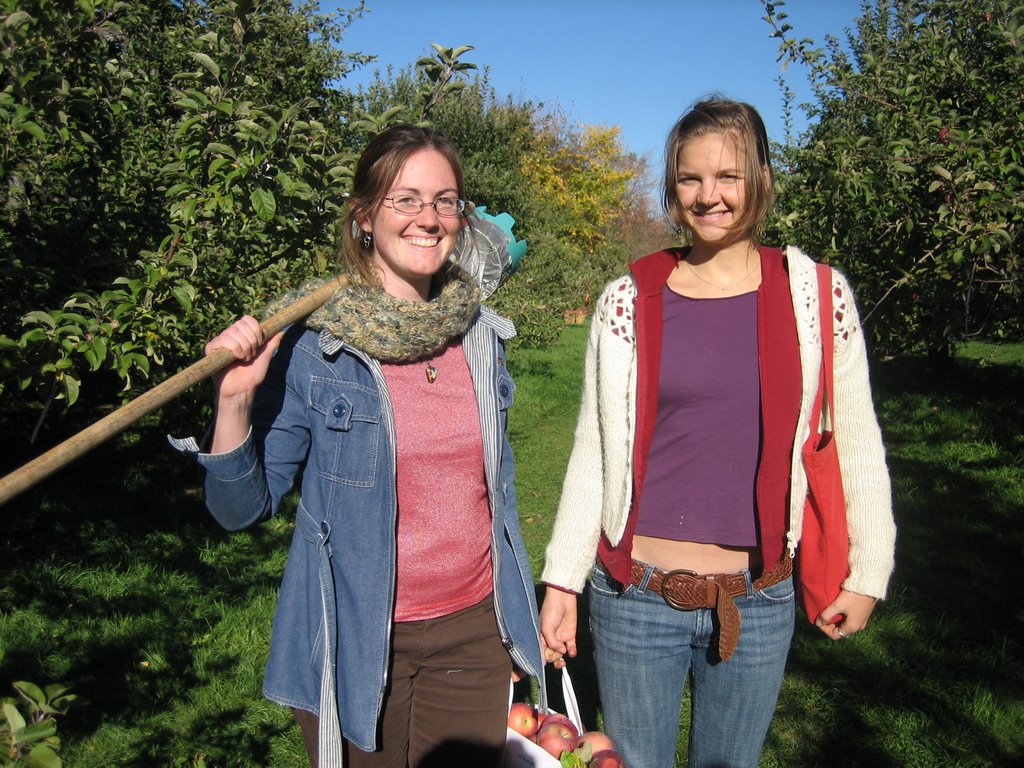
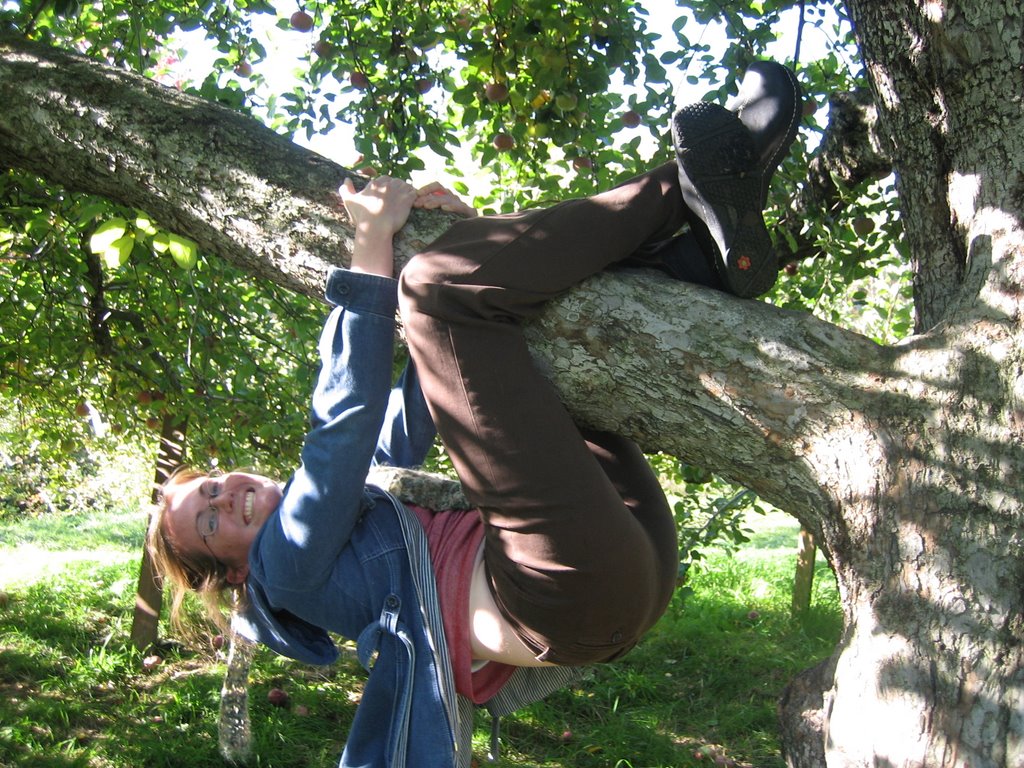
You know what they say about an apple a day....
My close friend from college spent the weekend with me and gave the perfect excuse to explore the joys and foliage of new england this time of year. We did some climbing, tons of eating, and enough lauging to last 'till the winter.
Tuesday, September 19, 2006
To my fan club
After being scolded twice this weekend by my loyal fans, I have kicked myself in front of this computer to update the annals.
After many Mondays spent claiming "I think I will start work NEXT" Monday, and weeks of follow up phone calls, faxes, and getting all my various licensure papers in order, I have finally started, and finished my first week of orientation as a nurse at a real hospital.
Due to self-advocacy and incessant follow up, I have finally landed a job at a community sized hospital about 15 minutes away from my house. The most inspiring fact about this job isn't the union, which will certainly be an interesting component, but the staunch mission of this hospital to create a healthier community. Indeed, it is as close as I have come to the clinic in
Acting as a perfect compliment, I have also started to volunteer for my favorite non-profit, Partners in Health, as a research assistant. I feel when I go to work, as if I am meeting my favorite movie stars. Yesterday, surrounded by good company and co-workers, I attended the most eloquent, opinionated, passionate talk by Steven Lewis, the UN special Envoy for AIDS in
He also stated the crazy fact that the US and England combined spends about 10 billion each MONTH on the War in Iraq (killing people) and less than 8.5billion on AIDS in Africa, a disease that is killing 900 people every hour. His book, a Race against Time, is well-written and passionate and sheds more eloquent light on this topic than I can. I recommend it.
So now, my task is to combine the exciting energy of an international non-profit and with the important work of nursing. Every patient, wherever they are living, deserves the best and most caring care possible. My own mission for the year is to provide this to each patient I have with the same energy that I feel while shrouded by the energy of my personal International-Health stars. Let's see, after 11 hours on my feet, while drowning in IV bags if I can manage this.
I think so.
Here's to good health - for those who really need it right now, those who have it, and those who dedicate their lives to working towards it for others.
Wednesday, August 30, 2006
Can't focus? Try Concerta
Last week I began and completed my first job as a real nurse. Save the fact that medications and a small dusty clinic were involved; the experience could not have been much more different than my time in
The job was posted on my school's list serve "RN needed for 1 week camp. Salary negotiable" on Monday. By Tuesday at 8am, I had rented a car, printed out Google-map directions, and was heading down the Mass Pike towards the
The week turned out to be less than a week of vacation and adventure. I played both nurse and pharmacist - bagging up hundreds of kids medicines a day (Zoloft, Zyrtec, Abilify, Allegra, Ritalin, Concerta, Singulair, etc.) and distributing the little coin-envelopes at breakfast, lunch, dinner and bed time.
In the time between the busy meals I saw tummy aches, scraped knees, fingers with splinters, unidentified back pain, black and swollen eyes, some stomach bugs and a whole handful of headaches. I pretended that I knew what I was doing sometimes, and knew others, and always gave a confident smile, checking the med recs for possible allergies before I distributed Advil. Amidst it all, there was little time for reading and knitting and the rain rendered my bathing suit all but useless.
The phenomena of medications at camp are a strange statement about our society. Perhaps only when we separate kids from their families, and put them in a group, do we see how truly medicated our children are. Here is a list of stats, printed by the NY Times this summer that puts some hard facts to the overwhelming numbers of pill bottles I encountered. What these numbers don't show are the amount of kids that take 4, 5, 6, or 10 prescription medications a day.
Total
One or more Daily prescription medications: 40%
Asthma/Allergy: 20%
Most prescribed medications:
Zyrtec (allergy)
Allegra (allergy)
Singulair (allergy and asthma)
Attention-deficit disorder/Attention-deficit hyperactivity disorder: 8%
Most prescribed medications:
Concerta
Strattera
Adderall
Depression/Anxiety: 3% (yes. I handed an 11 year old Zoloft each morning, not to mention the 15, 16, 17 and 18 year olds. I thought that adolescents’ and teenage years were supposed to be difficult....)
Most prescribed medicines:
Zoloft
Paxil
Prozac
Wellbutrin
Antipsychotic/Mood disorder: 2% (We had a slightly higher percentage. I think about 3-4% of our kids had 'mood disorders.' I made the mistake of giving one young woman on abilify her pills a few hours late. By that time she had already had a break down. Some are teetering on a scary edge of normalcy)
Most prescribed medicines:
Most prescribed medicines:
Clonidine
Lexapro
Risperdal
Depakote
Add the next category - in my camp - anti anxiety drugs. Trazadone, Clonopin, Xanax. Yikes! They're only 11 years old....
Bed-wetting: 1% (We had only one kid who used a pharmaceutical for this problem. I assume it didn't work like it was supposed to - as this kid showed up to use the washer dryer one morning - an embarrassed look spread across his face as he clutched a plastic bag of wet bedclothes.)
So that was the week - in a nut shell. It illustrated a pharmaceutical crisis that is overwhelming children. When I tried to confirm the appropriateness of doses with my Palm, many of the medications stated that they had not been tested on children. I can not help but repeat my new mantra of 'we don't know what it's doing to kids. We have no idea of the long term effects.' Weight gain, increasingly unstable moods, a rise in autism, and (perhaps worst of all) the concept that "whatever the problem, I will just swallow a little white pill and it will all be better."
Scary thoughts. But, now that the envelopes have been thrown away, and pill bottles have been sent home with kids, a good and challenging week over all.
Monday, August 14, 2006
Subscribe to:
Posts (Atom)